Dolly Clamp
A portable clamp-on caster system for safely moving furniture in constrained wood working shops. This project was completed in 3 months and was sponsored by Rockler.
A project by Isidora Mack, Eliar Meraz, Sanjana Prakash, Nate Simcik, Dustin Laufenberg.
University of Minnesota, 2023.
MY CONTRIBUTION
-
Led iterative physical prototyping from early mockups through final functional prototype
-
Constructed and assembled the full-scale working prototype, integrating clamping, wheel engagement, and stability mechanisms
-
Designed and executed user testing sessions to evaluate ergonomics, safety, and maneuverability
-
Synthesized user feedback into mechanical design refinements and system improvements

BACKGROUND
User Research
Woodworkers frequently build large furniture in small, cluttered workshops. Once assembled, these pieces can weigh several hundred pounds and are difficult — and often unsafe — to reposition. Existing solutions lacked stability, required multiple people, or weren't adaptable for different kinds of furniture.
We conducted user interviews to better understand this painpoint and to develop design requirements.
Of Rockler’s current user base is over 55, a demographic that faces a higher risk of injury.

“When I had to move a table I built, I didn’t have help … it took ages to get it out of my shop."


Building large cabinets is a popular project; Rockler has a portion of their website dedicated to cabinetry hardware.
Moving heavy objects can result in injuries like pulled muscles and pinched nerves; risk increases when moving without help.
Building large projects in cluttered and small spaces requires more modularity to move items.
Key Design Requirements:
-
Sturdy base for safety
-
Clamps to furniture
-
Handle for maneuverability
-
Stores easily
-
Works with different kinds and sizes of furniture
Market Benchmarking

PROTOTYPING AND ITERATION
Prototype 1
The first prototype validated feasibility of the clamp-on mobility concept.
Key features:
-
Base platform with integrated caster wheels
-
F-clamp tightening mechanism
-
Winch strap stabilization
User testing revealed mechanical shortcomings:
-
Wheels positioned under the base made loading difficult
-
No locking mechanism led to uncontrolled rolling
-
Winch strap was unnecessary and added complexity
-
Quick-action clamp required high grip force
These insights reframed the design from “does it move?” to “does it move safely and intuitively?”


Prototype 2
I led construction of the second prototype, focusing on:
-
Controlled wheel engagement via kick-down lever
-
Improved loading access by repositioning wheel geometry
-
Increased structural rigidity to reduce deflection under load
-
Simplified mechanism by removing unnecessary components
We also refined clamp orientation to improve ergonomics and reduce protrusion into workshop space.
Client feedback confirmed preference for:
-
Vertical clamp architecture
-
Larger ergonomic handle
-
Simplified mechanical profile
This iteration improved both stability and user confidence.
FINAL DESIGN
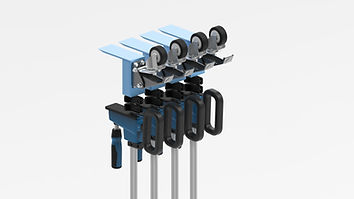
The Dolly Clamp was engineered around load stability, controlled mobility, and independent use. Instead of a centralized dolly, we designed four independent clamp units to distribute weight evenly across furniture corners, reducing tipping risk and improving balance. A wedge interface increases contact area and minimizes stress on finished surfaces. By separating wheel engagement from clamping force, the system maintains stable vertical load support whether the caster wheels are deployed or not. The design supports up to 500 lbs and is optimized for furniture under four feet.
To eliminate lifting, we developed a kick-down lever mechanism that allows users to clamp the unit securely, step to deploy the wheels, and move the furniture safely. This separation of lifting and actuation forces significantly reduces physical strain. A locking mechanism prevents unintended rolling, reinforcing both safety and user confidence.
Given Rockler’s primarily 55+ customer base, ergonomic considerations were central. A large-diameter vertical handle improves torque transfer while reducing grip strength requirements and wrist strain. These refinements were directly informed by iterative user testing.
The modular architecture supports scalability, uses off-the-shelf caster components to manage cost, and aligns with Rockler’s existing manufacturing ecosystem, targeting a ~$64 price point. The final prototype demonstrated stable load support, controlled mobility, and true single-user operation—transforming heavy furniture into a temporary mobile system without compromising structure or aesthetics.
-
Parallel clamp handle to adjust the height
-
Rockler Logo
-
Extra stability for the furniture
-
Wedge under the furniture
-
Press in latch to rotate handle
-
Handle can be oriented vertically or horizontally
-
Kick down lever
-
Castor wheels
5
6
7
8


1
2
3
4

Renderings showing the storage options, handle orientations, and exploded view.

In context rendering of the dolly clamps in use with a dresser. Rendering was done by Nate Simcik.